
Kinship care is the most common form of out-of-home care in Australia. It is the fastest-growing placement type in Victoria. Most kinship carers take on this role suddenly, without preparation, and without knowing what support they are entitled to. Grandparents with a grandchild suddenly placed with them, aunties who step up when a sibling cannot cope, cousins who become carers overnight. These families keep children connected to family and culture when the alternative is placement with strangers. Yet the system is hard to navigate and the financial support available is poorly understood. This guide covers kinship care types, Centrelink support for informal carers, Aboriginal kinship care, and how to formalise a private arrangement.
In short: a kinship care arrangement is when a grandparent, other relative or close family friend raises a child who can’t live with their parents. Formal (statutory) kinship carers approved by Child Protection receive a state care allowance. Both formal and informal kinship carers may be able to get Centrelink payments such as Family Tax Benefit and the Foster Child Health Care Card. The free Grandparent, Foster and Kinship Carer Adviser line on 1800 245 965 can tell you what applies to you.
What Is Kinship Care?
Kinship care is care by a relative or member of a child’s social network when the child cannot safely live with their parents. Kinship carers include grandparents, aunts and uncles, older siblings, cousins, step-parents, and close family friends with a genuine prior relationship with the child.
At 30 June 2024, there were 44,900 children in out-of-home care in Australia. Of those, 39.5% were placed with a grandparent or grandparents (AIHW, 2025). Kinship care is mandated as the preferred placement across every Australian state and territory. When a child cannot live with their parents, the child protection system must look to family and community first.
Research shows that children in kinship care have better emotional, developmental, and identity outcomes than those placed with unrelated carers. Remaining connected to family, community, and culture reduces the trauma of removal. Children in kinship placements are more likely to maintain sibling relationships and return to their parents when it is safe to do so.
Statutory vs Informal Kinship Care: The Difference That Determines Your Support
The most important distinction is whether the arrangement is statutory or informal. This determines what financial support you can access, what assessment you need to undergo, and what formal services are available to you.
Statutory (Formal) Kinship Care
Statutory kinship care occurs when Child Protection places a child with you, or when a court order allocates parental responsibility to you. You are assessed and approved by Child Protection or an accredited agency. You receive a state government care allowance and are eligible for formal support services and training.
The assessment process for statutory kinship care involves two stages. A preliminary assessment (Part A) is completed before or at the point of placement. This covers a WWCC and a National Police History Check for all adults aged 18 and over. In Victoria, the WWCC must be applied for within 21 days of placement and renewed every five years. A comprehensive Part B assessment follows for any placement expected to last more than six weeks. It must be completed within those first six weeks. Part B assesses your capacity to meet the child’s ongoing needs, your relationship with the child, and your household’s ability to provide stability.
The assessment for kinship carers is generally less intensive than for general foster carers. The focus is on the existing relationship and capacity to provide stability, not on finding a perfect carer in the abstract.
Informal (Private) Kinship Care
Informal kinship care describes private family arrangements without Child Protection involvement or a court order. The family has arranged this themselves. The carer has not been assessed or approved by the state.
Informal arrangements are vastly more common than most people realise. Research estimates there are approximately three times as many children in informal relative arrangements compared to those in statutory kinship care. These families are largely invisible to the system. They receive minimal formal support and have historically managed without the financial assistance available to formal carers.
Informal carers are not eligible for the state government care allowance. However, they can still access a meaningful range of Centrelink payments regardless of whether the arrangement is formal or informal.
State Care Allowances for Statutory Kinship Carers
Each state and territory sets its own care allowance rates. These are reviewed and updated periodically. The following reflects current arrangements as of mid-2026. Always confirm current rates with your state’s child protection department or caseworker.
Victoria
The Victorian DFFH pays assessed and approved kinship carers a fortnightly care allowance. The allowance is non-taxable and does not count as income for tax returns, Centrelink, or loan applications. Kinship carers automatically receive a Level 1 allowance at the start of placement. Where a child is assessed as having higher needs, the carer may be eligible for a higher allowance level. Client support funding is also available for extraordinary expenses such as therapy services, bedding, and essential items at placement commencement. Aboriginal kinship carers have access to Aboriginal kinship support services in every DFFH Division.
New South Wales
In NSW, the Department of Communities and Justice (DCJ) provides care allowances to relative and kinship carers. Revised DCJ care allowance rates came into effect from 1 July 2025. Supported care allowances apply where parental responsibility has been allocated through a Children’s Court order or certain Family Court orders. The care allowance is not taxable income and does not affect any Centrelink payments or Commonwealth benefits. Establishment payments are available to cover essential items when a child first comes into care, including school uniforms, bedroom furniture, bedlinen, and clothing. These are not automatic and should be discussed with your caseworker before making purchases. Post-care supports include help for young people aged 18 to 24 completing their Higher School Certificate.
Queensland
Queensland carers and guardians receive an annual payment for each child in their primary care to support participation in extracurricular activities. Payments are automatic, split evenly between July and January, based on care arrangements in place on 1 July and 14 December. Activities can include swimming lessons, sports clubs, playgroups, and equipment. In Queensland, young people who move to independence can also receive ongoing support until their 21st birthday through Extended Post Care Support. Queensland allowances are indexed in January each year in line with the consumer price index — check the current amounts with the Queensland Government.
What Centrelink Payments Are Available to Kinship Carers?
Centrelink provides a range of payments to both formal and informal kinship carers. The mix you are eligible for depends on your specific circumstances, the child’s situation, and whether your arrangement is formal or informal. Always check current rates and eligibility with Services Australia, as amounts are indexed regularly.
The free Grandparent, Foster and Kinship Carer Adviser line (1800 245 965) is the best starting point. Advisers give tailored information, can arrange specialist appointments including social workers, and provide referrals to federal, state, and community services. They are available to both formal and informal carers.
Family Tax Benefit Part A and Part B
Family Tax Benefit (FTB) Part A is paid per child and helps with the costs of raising children. FTB Part B gives extra help to single parents, grandparent carers, or families with one main income. Both are available to formal and informal kinship carers, including grandparents caring for grandchildren in both statutory and private arrangements.
Foster Child Health Care Card
This card is one of the most important and least-known supports for informal kinship carers. There is no income test and no assets test. The card is issued in the child’s name, not the carer’s. Cheaper medicines and some Medicare-related entitlements are included. You do not need to be a formal carer to access it. You must apply for a new card for each child who comes into your care. This means grandparents and other family members in informal arrangements can access this even without any formal assessment.
Child Care Subsidy
Child Care Subsidy helps with the cost of approved child care. You may be eligible if you have at least 14% care of the child and are responsible for paying child care fees. Grandparents on income support may access Additional Child Care Subsidy (Grandparent): up to 100 hours of subsidised care per fortnight.
Parenting Payment, Carer Payment, and Carer Allowance
Parenting Payment may be available for primary carers of a child under 8 as a single carer, or under 6 if partnered. Carer Payment is available if you provide constant care for someone with a significant disability or medical condition and meet the income test. Carer Allowance is an additional fortnightly payment for carers providing daily care to a child with a disability or medical condition. Our guide to Carer Payment and Carer Allowance explains eligibility and how to apply, and support for carers in Victoria covers respite, counselling and Carer Gateway. Both payments may apply where the child you are caring for has significant health or disability needs.
Double Orphan Pension
The Double Orphan Pension helps with the costs of caring for a child when specific circumstances apply. This applies where one parent has died and the other is imprisoned, or where a refugee child has both parents outside Australia. There are no income or assets tests for this payment.
Important: The Care Allowance Does Not Affect Centrelink
This point is critical and almost universally missing from kinship care guides. The state government care allowance is non-taxable and does not count as income for any Centrelink payment calculation. Care allowance rates are not affected by Centrelink or Commonwealth child support agency payments. Youth Allowance received by a young person aged 16 or older does not affect the care allowance. Knowing this matters because many carers incorrectly assume receiving state allowances will reduce their Centrelink entitlements.
Aboriginal and Torres Strait Islander Kinship Care
Aboriginal kinship care is not simply a cultural preference. The ATSICPP applies in child protection law across all Australian states and territories and makes Aboriginal kinship care a legally recognised priority.
At 30 June 2024, First Nations children made up 45% of all children in out-of-home care (AIHW, 2025). First Nations children were nearly 11 times more likely than non-Indigenous children to be in out-of-home care. In Victoria, First Nations children were 20.1 times more likely to be in kinship care than non-Aboriginal children (Victorian Auditor-General’s Office). Of all First Nations children in out-of-home care at 30 June 2024, 63% were living with relatives, kin, or other First Nations caregivers.
Target 12 aims to reduce Aboriginal children’s over-representation in out-of-home care by 45% by 2031. This target reflects national acknowledgment that the current level of over-representation represents a systemic failure requiring active reform.
The Five Elements of the ATSICPP
The ATSICPP guides placement decisions through five elements:
- Prevention: Supporting families with culturally safe services to prevent the need for child protection involvement
- Partnership: Aboriginal and Torres Strait Islander communities and organisations having genuine decision-making roles in policies and processes affecting their children
- Placement: When a child must be placed outside the home, preference is given to Aboriginal and Torres Strait Islander family and kin, then Aboriginal and Torres Strait Islander carers, before considering non-Indigenous carers
- Connection: Ensuring children maintain connections to family, community, culture, and Country throughout their time in care
- Participation: Children, families, and communities having a genuine say in decisions that affect them
In Victoria, Aboriginal kinship support services operate in every DFFH Division. These services provide specialist support to Aboriginal kinship carers and help maintain children’s cultural connections throughout placements.
In NSW, the government is progressively transferring case management of Aboriginal children and young people in out-of-home care to Aboriginal Community-Controlled Organisations (ACCOs). The transfer prioritises non-Aboriginal carers of Aboriginal children first, followed by Aboriginal carers of Aboriginal children. The aim is to ensure Aboriginal children receive culturally safe care and case management by organisations with deep community connection.
Kinship Care and the NDIS
Many children entering kinship care have disability or developmental delay. This creates an important intersection between the kinship care system and the NDIS that most kinship care guides do not address.
A child in kinship care can access the NDIS if they meet the eligibility criteria. Kinship carers are key contributors to NDIS planning. They provide information about the child’s strengths, interests, goals, and daily support needs that only someone in close daily care can provide. Their knowledge is central to building an effective NDIS plan.
NDIS supports for children in out-of-home care must be reasonable and necessary and are additional to what the out-of-home care system already provides. The NDIS does not replace the state’s responsibility to fund care. Supports may include therapy, behaviour support, assistive technology, home modifications, transport, support coordination, and early childhood supports.
The fortnightly care allowance is not affected by a child accessing NDIS funding. Where a child was receiving a complex support needs allowance for disability costs, it may be adjusted once NDIS supports are in place.
Children under 9 may access supports through the NDIS Early Childhood Approach if they have developmental concerns or disability. Children under 6 do not need a formal diagnosis to begin receiving some early supports through this pathway. This is relevant for kinship carers who have recently taken on a young child and are still waiting on a formal assessment.
One consistent challenge for kinship carers of Aboriginal children with disability is access to timely diagnosis and assessment. Without a formal diagnosis, some NDIS pathways are more difficult. Carers in this situation can ask their caseworker or an advocacy service about assessment options through child protection or the NDIS Early Childhood pathway.
The Unique Pressures Kinship Carers Face
Kinship care is different from foster care in ways that are often underestimated by service systems. Foster carers take on children they did not previously know, within a system designed to prepare and support them. Kinship carers step up for family members, often suddenly and without preparation, within relationships that are already complex.
Common challenges include managing contact with the child’s parents, unexpected financial pressure, social isolation, and exhaustion from caring for children who have experienced trauma.
Kinship carers are typically older than foster carers. Many are grandparents or great-grandparents, often on fixed incomes, who did not anticipate raising children at this stage of life. Culturally and linguistically diverse kinship carers face additional barriers including language, mistrust of government systems, and unfamiliarity with Australian processes.
Children entering kinship care almost always carry the effects of what led to placement: parental substance misuse, family violence, mental health difficulties, or neglect. A kinship carer may be managing a child’s trauma responses while processing their own grief and stress about what has happened to their family. These needs are real, persistent, and rarely met by a single service.
How to Formalise an Informal Kinship Arrangement
If you are caring for a child informally and want to access the care allowance and formal services, there are two main pathways.
The first is through the family law system. A family law parenting order gives legal recognition to your caring role without necessarily involving Child Protection. Some states recognise certain Family Court orders for the purposes of care allowance eligibility. Speak with a family lawyer or legal aid for advice specific to your situation.
The second pathway is through Child Protection. If you contact your state’s Child Protection service, they will assess whether a formal intervention and placement is appropriate. If the child is placed formally with you through this process, you become eligible for the care allowance and formal support services.
Many informal carers fear that contacting Child Protection will result in the child being removed from their care entirely. In practice, child protection systems across Australia prioritise keeping children within family and community. Reaching out is far more likely to lead to formal recognition and support than to removal.
Why Choose Nhanya Foundation for Kinship Family Support
Nhanya means persistence. Kinship care demands that kind of sustained commitment: years of uncertainty, legal processes, school meetings, therapy appointments, and sleepless nights. We work alongside people who are carrying exactly this kind of load.
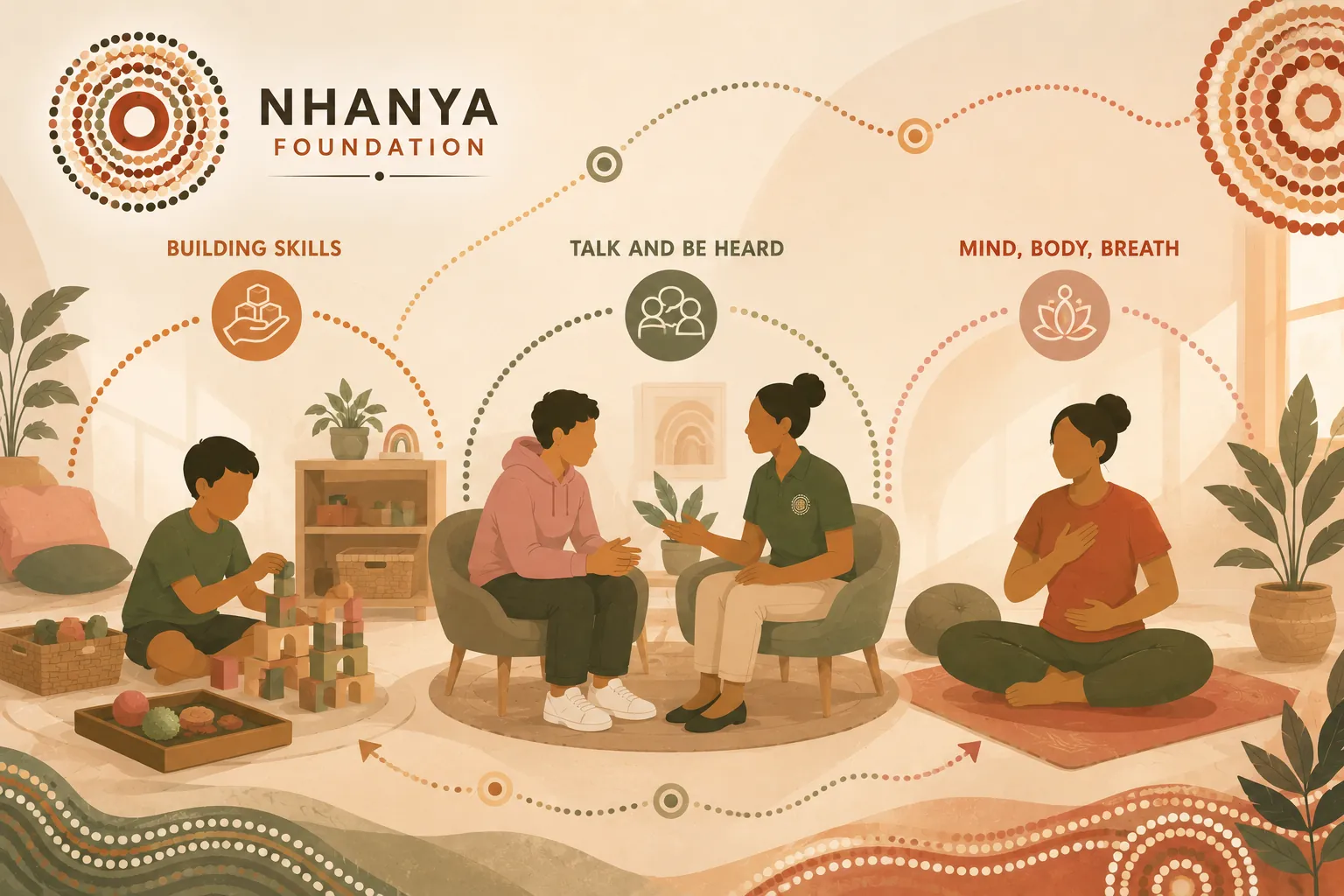
Nhanya Foundation is a Melbourne-based not-for-profit organisation and registered charity. Our services are focused on women, children, and young people navigating complex systems, including kinship families in Victoria. We understand that kinship carers are often the most committed and the most exhausted people in a child’s network. They frequently fall through the gaps between child protection and mainstream services.
Our Advocacy and Service Navigation service helps kinship carers understand their entitlements, navigate child protection, and connect with financial and community supports. For carers overwhelmed by the system, this navigation support can make an immediate practical difference.
Nhanya’s Allied Health Therapy Services include occupational therapy, psychology, speech pathology, physiotherapy, and behaviour support for children and young people with disability or developmental needs. Our allied health team can conduct assessments, write supporting reports, and participate in NDIS planning for children in kinship care.
The Support Coordination service helps kinship carers managing a child’s NDIS plan alongside day-to-day care demands. Coordinating therapy, behaviour support, and daily disability supports within a kinship placement is complex. A Support Coordinator can take significant load off carers who are managing this alongside everything else.
The Accommodation Support service assists kinship carers and young people who face housing instability as a result of the placement.
The Assertive Outreach and Stabilisation Program reaches young people aged 12 to 25 who have disengaged from services. For kinship carers managing a teenager who has disengaged from school, this program provides intensive support to stabilise the placement.
Nhanya’s Youth Strength and Recovery Workshops and Skills for Life and Independence Program help young people in kinship care build life skills and emotional regulation.
Nhanya Foundation is a not-for-profit organisation and registered charity. Our services are guided by community benefit, not private profit. Any proceeds are reinvested into charitable activities supporting people experiencing hardship and disadvantage.
For current information on Nhanya’s NDIS registration, search the NDIS Commission Provider Register at ndiscommission.gov.au.
Contact Nhanya Foundation at nhanya.org.au/contact or call 03 8595 9012. You can also call the NDIS on 1800 800 110 for NDIS-specific queries. Referrals to Nhanya can be submitted at nhanya.org.au/referral.
Frequently Asked Questions About Kinship Care Australia
What is kinship care in Australia?
Kinship care is the care provided by a relative or member of a child’s social network when they cannot live with their parents. At 30 June 2024, there were 44,900 children in out-of-home care in Australia, 39.5% placed with a grandparent (AIHW, 2025). Kinship care can be statutory (court-ordered or Child Protection-arranged) or informal (private family arrangement). It is the preferred and fastest-growing form of out-of-home care in Australia.
What payments can kinship carers receive in Australia?
Statutory kinship carers receive a non-taxable fortnightly state care allowance that does not affect Centrelink entitlements or count as income for loans. Both formal and informal kinship carers can access Family Tax Benefit A and B, Child Care Subsidy, and the Foster Child Health Care Card. Call the free Grandparent, Foster and Kinship Carer Adviser line (1800 245 965) for personalised guidance. Check current rates with Services Australia.
Are informal kinship carers eligible for payments?
Informal kinship carers cannot access the state government care allowance, which requires formal assessment and approval. However, they can still access Family Tax Benefit A and B, Child Care Subsidy, and the Foster Child Health Care Card. Non-parent carers living in the same house as a parent are generally not eligible for most payments. Call 1800 245 965 to understand what applies to your specific arrangement.
What is the assessment process for kinship carers?
Assessment involves a Part A preliminary check (WWCC and police check) and a Part B assessment within six weeks for longer placements. In Victoria, the WWCC must be applied for within 21 days and renewed every five years. The process focuses on the existing relationship and capacity to provide stability for the specific child.
What is Aboriginal kinship care?
Aboriginal kinship care is care by Aboriginal relatives or community members where family, culture, and Country are central to the child’s safety. The ATSICPP guides placement decisions through five elements: Prevention, Partnership, Placement, Connection, and Participation. At 30 June 2024, First Nations children represented 45% of all children in out-of-home care despite being around 6% of the child population. The National Agreement on Closing the Gap Target 12 aims to reduce this over-representation by 45% by 2031.
Can kinship carers access NDIS support for children in their care?
Yes. Kinship carers are key contributors to NDIS planning for eligible children in their care. NDIS supports must be reasonable and necessary and are additional to what out-of-home care provides. Supports may include therapy, behaviour support, assistive technology, and support coordination. The care allowance is not affected by a child’s NDIS funding. Children under 9 can access the NDIS Early Childhood Approach; those under 6 do not need a formal diagnosis.
How can I formalise an informal kinship care arrangement?
Two main pathways exist: a family law parenting order through the Federal Circuit and Family Court, or formal placement through Child Protection. Formalising opens access to the state care allowance, establishment payments, and formal support services. Most informal carers are reluctant to contact Child Protection, but in practice child protection systems prioritise keeping children within family and community. An advocacy service can help you understand which pathway suits your situation.
Are You a Kinship Carer in Victoria?
Our advocacy and service navigation team can help kinship families understand payments and entitlements, work through Child Protection and NDIS processes, and connect with local support.
Explore Kinship Advocacy & Navigation